


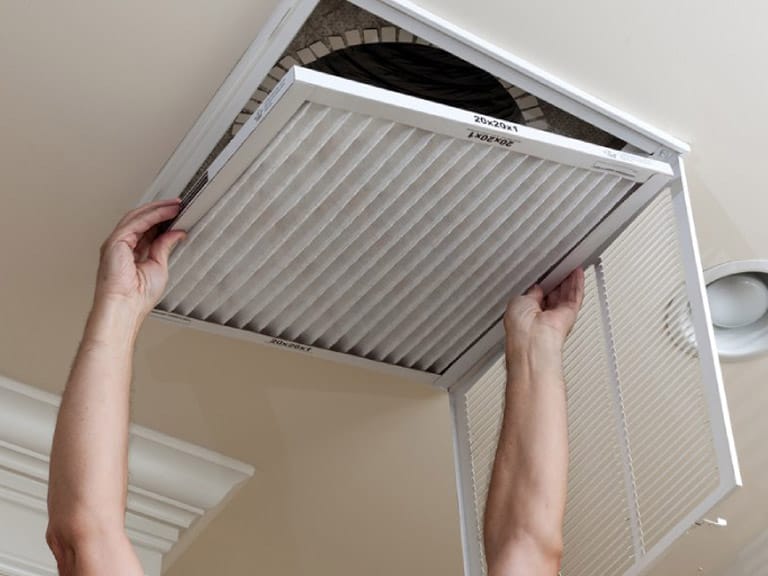
In Raleigh-area homes, your air filter (also called an HVAC filter) captures airborne dust and particles before they reach the blower and cooling coil. Seasonal pollen, pets and nearby construction all affect how quickly it loads. Choosing the correct filter—and replacing it based on the manufacturer’s interval and actual dust buildup, not a fixed twice-a-year habit—helps maintain proper airflow.
Your filter and your ductwork are two different things. A filter catches what is moving through the air now; it cannot remove dust, debris or construction residue already sitting inside the ducts. If that buildup is there, our air duct cleaning in Raleigh service removes it, starting with a free inspection and written quote. This guide explains MERV ratings, filter types, airflow compatibility and when to replace a filter.
1. What is an HVAC Filter?
An HVAC filter primarily helps protect the heating and cooling equipment from airborne particles and may also reduce particles circulating in the home. It is commonly installed in a return grille or near the air handler. Filters differ by size, construction and particle-capture efficiency.
The Science Behind Air Filtration
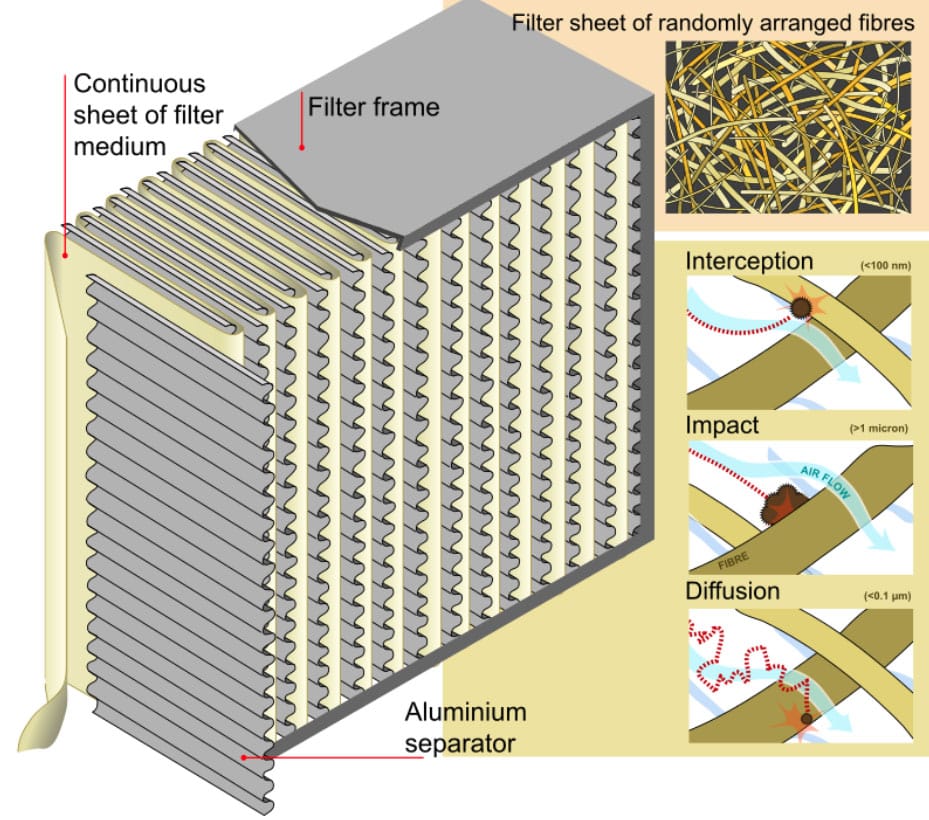
HVAC filters use different ways of capturing particles, and some specialty media also address certain odors:
Mechanical filtration: Filter fibers capture airborne particles moving through the media. This is the most common residential HVAC filter type.
Electrostatic filtration: Some filters use electrostatic effects to capture particles. Performance depends on the specific product and how it is maintained.
Activated carbon: Some products contain sorbent media designed to reduce certain gases or odors. Typical thin carbon layers have limited capacity; particle capture and odor removal are different functions.
Combination media: Certain filters combine particle-capture and odor-control materials. Check their published efficiency ratings and fit before choosing one.
For homes in Raleigh, Cary and Wake Forest, begin with the HVAC manufacturer’s filter specification, then consider household dust loading and the filter’s published performance.
Why Filter Quality Matters in North Carolina
Raleigh’s pollen seasons and humid summers make filter inspection and moisture control important. Humidity alone does not establish mold in ductwork. If an HVAC inspection finds suspected growth or water damage, our HVAC mold remediation near me service addresses HVAC-specific concerns; fixing the underlying moisture source remains essential.
A properly selected and maintained filter helps protect the blower and cooling coil from particle buildup. A clogged or overly restrictive filter can reduce airflow. Higher MERV is not automatically better for a particular system.
2. How to Choose the Best Air Filter for Your Raleigh Home
Choose a filter that matches the exact dimensions and specifications of your HVAC equipment. Consider MERV rating, filter thickness, the amount of surface area, manufacturer recommendations and how quickly the existing filter becomes dirty.
Understanding MERV Ratings
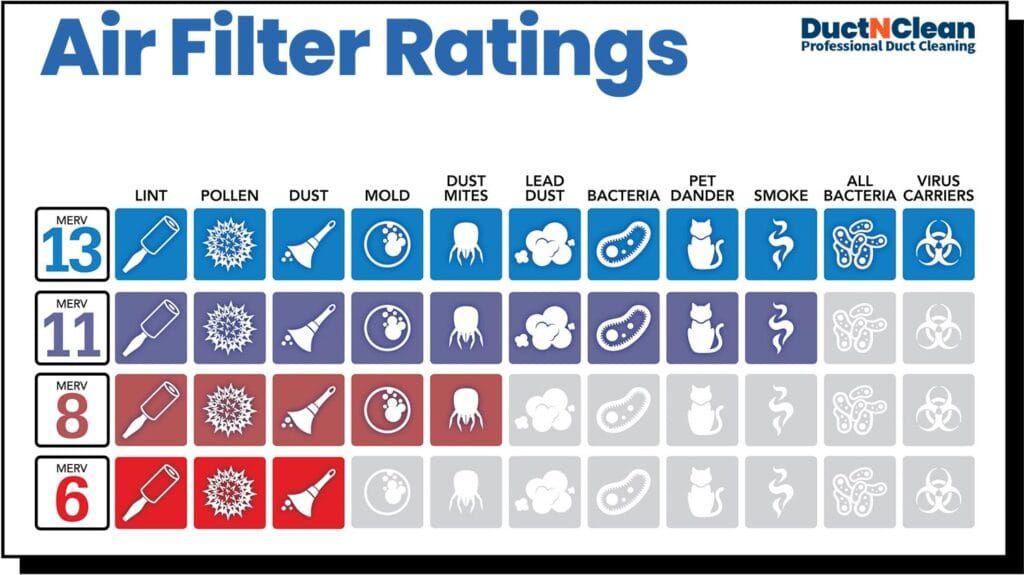
MERV stands for Minimum Efficiency Reporting Value, a standardized rating for how efficiently a filter captures particles across tested size ranges. The highest available MERV is not necessarily appropriate for every HVAC system.
MERV 1–4: Low-efficiency filters capture relatively large particles and offer limited capture of smaller airborne particles.
MERV 5–8: An improvement in particle capture over basic filters. The right choice still depends on HVAC equipment and airflow requirements.
MERV 9–12: Captures a higher share of smaller particles than lower-rated filters. Check system compatibility and pressure-drop specifications.
MERV 13–16: Higher-efficiency filters capture more fine particles, but some systems cannot accommodate the associated airflow resistance without suitable filter area or design changes.
The Sweet Spot for Wake County Homes
For many systems, a compatible pleated filter in the MERV 8–13 range can be considered, but there is no universal best rating. Use the equipment manufacturer’s recommendations and ask an HVAC technician about airflow or pressure-drop concerns before increasing filter efficiency.
Do not force a high-MERV filter into equipment designed for less restrictive media. Improper fit or excessive pressure drop can reduce airflow, even when the filter itself has a higher efficiency rating.
Types of Air Filters Available
Fiberglass Filters
- Pros: Generally inexpensive and low resistance when correctly selected.
- Cons: Limited capture of smaller particles; performance varies by product.
- Best for: Systems and applications where the manufacturer permits this type.
- Replacement: Inspect and follow the product’s recommended interval; replace sooner if loaded.
Pleated Filters
- Pros: Greater filter area and available in a range of MERV ratings.
- Cons: Must be matched to the system’s airflow and pressure-drop limits.
- Best for: Many residential systems when dimensions and specifications match.
- Replacement: Follow manufacturer instructions; thickness and dust loading affect lifespan.
Electrostatic Filters
- Pros: Some options are reusable and capture particles using electrostatic effects.
- Cons: Efficiency and cleaning requirements vary; reusable products must be maintained correctly.
- Best for: Compatible systems when the owner can follow maintenance instructions.
- Maintenance: Follow specific washing or replacement instructions; dry washable media completely.
HEPA Filters
- Pros: True HEPA media are tested to capture at least 99.97% of 0.3-micron particles under the applicable test conditions.
- Cons: High airflow resistance; generally requires a system specifically designed for HEPA filtration.
- Best for: Dedicated air-cleaning systems or HVAC configurations designed to accept HEPA media.
- Replacement: Follow the HEPA unit’s manufacturer instructions; there is no universal interval.
Washable Filters
- Pros: Reusable if designed and maintained correctly.
- Cons: Performance varies; incorrect washing, damp reinstallations or poor fit can create problems.
- Best for: Systems that explicitly support the washable filter and its cleaning requirements.
- Maintenance: Clean and replace only as directed by the manufacturer.
Special Considerations for Raleigh Area Homes
Homes with pets: Pet hair and dander can load filters faster, so inspect the filter more often and replace it when it is loaded. Hair and dander that get past the filter can also settle inside the ducts over time—see why Raleigh pet owners need regular duct cleaning.
Pollen and allergy concerns: A suitable higher-efficiency filter may help reduce airborne particles, but filtration is not a guaranteed treatment for symptoms. Consider these practical measures:
- A higher MERV rating only when compatible with your HVAC system
- Check filters more frequently when dust loading is visibly higher
- Consider a suitably sized portable air cleaner for additional particle removal
- Professional air duct cleaning Raleigh NC services restore optimal airflow when an inspection finds dust and debris built up inside the ducts.
Nearby construction or busy roads: If more outdoor dust enters the home, inspect filter loading and keep the filtration system properly sealed and maintained.
- Filters with suitable dust-holding capacity and dimensions
- A MERV rating compatible with your equipment
- More frequent inspections rather than a fixed percentage-based schedule
- Supplemental portable air purifiers in heavily used rooms
Moisture concerns: Filters can capture some airborne spores, but they cannot correct leaks, condensation or established mold growth. Address moisture sources and evaluate suspected HVAC contamination separately.
- Compatible particulate filters, while recognizing that moisture control is the priority
- Assessment of moisture or condensation rather than automatic UV installation
- Keep indoor relative humidity around 30–50% and below 60%
- HVAC-specific evaluation and remediation if actual growth is suspected
3. Signs It’s Time to Replace Your HVAC Filter
A visibly loaded filter, the manufacturer’s replacement interval, or reduced airflow are the main signs your air filter needs attention. Some of these signs overlap with the signs your air ducts need cleaning; if a fresh filter doesn’t solve the problem, a free inspection can confirm what is inside the ducts.
Visual Inspection Methods
Inspect your filter periodically for heavy dust accumulation, damage, moisture or a poor seal around the frame. Comparing it to a fresh filter of the same type is useful, but the ability to see light through a filter is not a reliable universal replacement test.
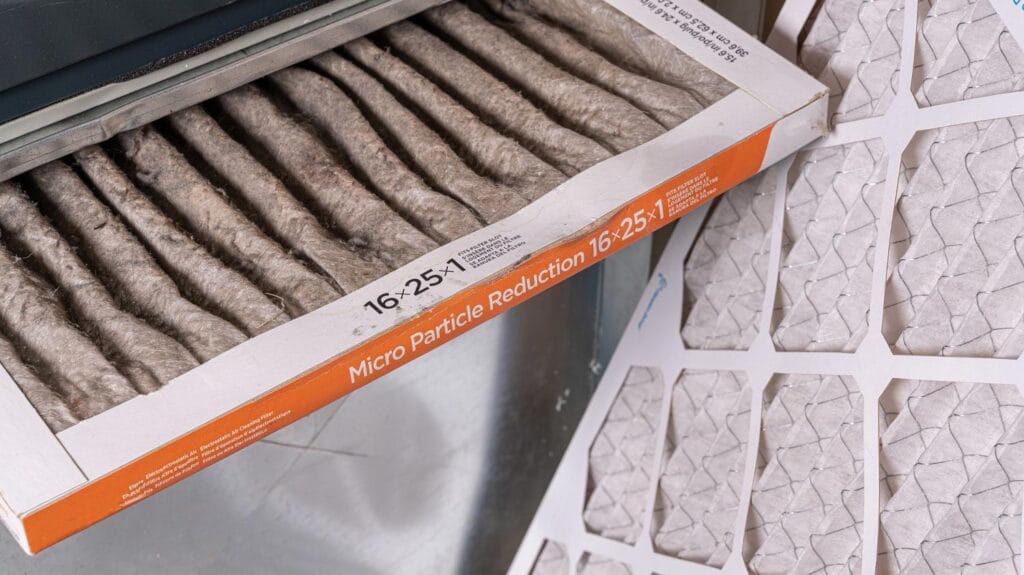
What to look for on the filter:
- Gray or dark coating: Normal dust loading; replace the filter when it is heavily coated
- Damp filter or wet frame: Points to a moisture or condensation problem; find and fix the cause
- Fuzzy or spotted patches with a musty odor: Don’t guess from appearance; have the HVAC system inspected
- Unusual staining: Color alone cannot identify mold, bacteria or chemicals
If you find a damp filter or growth-like spotting, replace the filter and address the moisture source. If you suspect growth inside the HVAC system itself, an inspection can confirm what is actually there.
Performance Indicators
Higher energy bills: A heavily clogged filter can contribute to poor system performance, but energy costs also depend on weather, thermostat settings and equipment condition. A specific percentage increase cannot be inferred from the filter alone.
Reduced airflow: A loaded filter is one possible cause. Check the filter first, but blocked vents, duct restrictions and HVAC equipment issues can also affect airflow.
Longer run times: Filter restriction is one possible contributor, but weather, sizing and other HVAC faults may also be responsible.
Dust on furniture: Dust may come from outdoor air, fabrics, activity or other household sources. A loaded filter is one thing to check, along with leaky return ducts and debris already inside the ductwork.
Uneven temperatures: Check for a dirty filter, but persistent hot and cold spots require a broader HVAC assessment rather than assuming the filter is the sole cause.
Allergy symptoms: Symptoms alone do not establish filter performance or contamination in ducts. Consider filtration, housekeeping and appropriate medical advice as separate matters.
Frequent cycling: Filter restriction can sometimes contribute to system problems, but frequent on/off cycling can have several causes and should be checked by an HVAC technician.
Time-Based Replacement Guidelines
Check your filter regularly, especially after dusty renovation work or during heavy HVAC use. These are typical intervals only; always follow the filter and equipment manufacturers’ instructions and replace sooner if visibly loaded:
- 1–2-inch filters: Often checked monthly; many products specify replacement around 1–3 months
- 4-inch filters: May last longer depending on media and product instructions
- 5-inch filters: May last several months; use the manufacturer’s actual schedule
Actual service life depends on filter design, thickness, runtime and dust load—not just pets or the season. Filter replacement is separate from duct cleaning, which is needed far less often. See how often Raleigh homes should have duct cleaning for guidance on when a duct inspection makes sense.
4. Seasonal Tips for Raleigh Homeowners
Raleigh’s seasonal pollen and long cooling season can change how fast a filter loads. Inspect filters rather than automatically applying a different replacement interval for each season.
Spring (March-May): Pollen Season Preparation
Spring pollen can add to household particle loads. How much reaches the HVAC filter depends on ventilation, window use and building conditions.
Recommended Actions:
- Inspect the filter more frequently when pollen exposure is high; replace when needed
- Check compatibility before considering a higher-MERV filter
- Monitor local pollen counts and adjust replacement frequency accordingly
- Keep windows closed and rely on your HVAC system for air circulation
For homes in Wake Forest and surrounding areas, check the filter more often if pollen or dust exposure is unusually high.
Summer (June-August): High Humidity and AC Usage
During summer, frequent air-conditioning use may increase the total air passing through the filter. Control indoor humidity separately; a filter is not a substitute for repairing leaks or condensation.
Recommended Actions:
- Inspect during periods of heavy system use and replace according to actual loading
- Check for damp filters or signs of moisture and investigate the cause
- Ensure proper humidity control (30–50% indoor levels)
- Don’t ignore persistent musty odors from the vents; have the source inspected
Fall (September-November): Second Pollen Peak
Fall pollen can affect some Raleigh households. Replace filters based on loading and manufacturer guidance, not a fixed date tied to ragweed season.
Recommended Actions:
- Continue checking the filter rather than assuming a mandatory 30–45-day replacement
- Prepare for the transition to heating season
- Address any summer moisture issues before heating begins
- Consider a higher-efficiency filter, if your system allows it, when family members are sensitive to ragweed
Winter (December-February): Heating Season Maintenance
In winter, filter life still depends on HVAC runtime, filter construction and actual dirt accumulation.
Recommended Actions:
- Replace the filter on its applicable schedule or sooner if loaded
- Monitor for increased dust from heating system operation
- Consider humidification to prevent overly dry air
- Schedule annual HVAC maintenance before peak heating season
Filter replacement and professional duct cleaning solve different problems. If dust keeps returning even with fresh filters, a free duct inspection can show what is actually inside your ducts.
5. Health & Cost Benefits of High-Quality Air Filters
A filter that is compatible with your system can help protect HVAC equipment and reduce some airborne particles. Benefits depend on how well the filter fits, how frequently it is changed and whether airflow remains adequate.
Financial Benefits
Equipment protection: Filtration can help reduce dust reaching components, but no credible universal number of extra years can be promised from a filter upgrade.
Airflow and efficiency: Replacing an overly dirty filter may help correct a restriction. A higher-priced or higher-MERV filter does not guarantee a specific percentage of energy savings.
Maintenance: Routine filter care is one part of HVAC maintenance; it does not eliminate breakdowns or replace professional equipment servicing.
Duct cleaning: Good filtration can slow how fast debris builds up in the ducts, but the timing of a cleaning should be based on the actual condition of the ductwork.
Health Benefits
Particle reduction: Proper filtration may reduce some particles circulating indoors, but an improvement in individual allergy symptoms cannot be guaranteed.
Respiratory sensitivities: Selecting a suitable filter may reduce exposure to certain particles. Filter selection is not a substitute for medical care.
Fine-particle capture: Some higher-rated filters capture more small airborne particles, but ordinary HVAC filtration does not guarantee prevention of infectious illness.
Comfort: A properly maintained HVAC system can support a comfortable home, but sleep or health improvements cannot be promised from filter choice alone.
Long-Term Value Proposition
When comparing filter value, consider fit, published efficiency, pressure drop, service life and actual replacement cost. The cheapest filter may not capture the particles you want, while the highest-rated filter may not suit your system.
For homeowners interested in comprehensive air quality solutions, our guide on the cost of duct cleaning in Raleigh helps you budget for complete system maintenance.
For a full picture of what professional service delivers beyond filtration, see our breakdown of the benefits of duct cleaning for Raleigh homeowners.
6. Expert Help from Raleigh’s Indoor Air Pros
Filter selection is routine homeowner maintenance. Duct cleaning is a separate service that removes the dust and debris a filter cannot reach once it is already inside the ductwork.
When to Consider Professional Duct Cleaning
Even the best filter cannot remove debris already inside your ductwork. Consider a free inspection when:
- Substantial debris is visible inside ducts or being discharged from supply registers
- Suspected mold growth is visible inside ducts or other HVAC components (this calls for an HVAC mold assessment, not routine cleaning)
- Water damage has affected the ductwork or HVAC components
- There is evidence of pests or rodents inside the ductwork
- You recently renovated, or it has been roughly 8–12 years since the ducts were last cleaned (or you don’t know)
Our air duct cleaning Raleigh page explains how DuctNClean inspects ductwork and recommends cleaning based on actual conditions.
Comprehensive HVAC Maintenance
Routine HVAC maintenance is best handled by a qualified heating and cooling contractor. Depending on system design, that work may include:
- Cleaning evaporator and condenser coils
- Checking refrigerant levels and electrical connections
- Inspecting and cleaning blower components
- Verifying proper system operation and airflow
For a broader discussion of HVAC upkeep versus duct cleaning, read HVAC maintenance and duct cleaning in Raleigh.
Seasonal Service Recommendations
Spring: Check filter condition and book qualified HVAC servicing if system performance is a concern.
Summer: Replace loaded filters and address moisture or cooling-performance problems through the appropriate contractor.
Fall: Continue filter inspections and arrange routine heating-system maintenance when due.
Winter: Monitor filter loading and consult an HVAC technician for unexpected heating problems.
For optimal timing of professional services, consult our guide on the best time to schedule duct cleaning in Raleigh.
Service Areas and Local Expertise
DuctNClean provides air duct inspections and cleaning in Raleigh and nearby Triangle communities, including:
- Raleigh: Serving Raleigh homeowners with specialized knowledge of urban air quality challenges
- Wake Forest: Homes in this fast-growing area get the same inspection-first air duct cleaning Wake Forest NC service
- Cary: From older neighborhoods to new builds, air duct cleaning Cary NC for every type of home
- Apex: New subdivisions mean construction dust, and our air duct cleaning Apex NC team handles it
Why Choose Professional Services
Local experience: Our team works with duct systems in Raleigh-area homes and considers visible debris and moisture conditions during inspection.
Inspection-first approach: We distinguish routine filter replacement from debris requiring professional duct cleaning.
Specialized cleaning equipment: When cleaning is warranted, we use appropriate collection and agitation methods to remove accumulated debris from the ductwork.
Clear findings: We explain what we observe and the recommended scope of work before starting a duct-cleaning job.
7. Conclusion: The Clean Air Advantage
A properly fitted, compatible air filter is an important part of routine home maintenance. Check its condition, follow equipment instructions and choose a MERV rating that does not compromise airflow.
Higher filter efficiency can improve particle capture, but it does not guarantee better health, lower utility costs or longer equipment life. Choose based on verified performance and system compatibility.
Your first steps are simple: use the correct filter size, inspect for loading and address any HVAC performance concerns.
DuctNClean focuses on inspecting and cleaning HVAC ductwork. Routine filter changes and HVAC equipment repair remain separate maintenance tasks.
Concerned about debris in your air ducts? Contact DuctNClean at 984-301-8445 for a free duct inspection. We will explain any findings and provide a written quote before any work begins.
Choosing the right HVAC filter is only one part of keeping your system clean. Explore our Raleigh air duct cleaning guides and expert tips for practical advice on dust buildup, seasonal maintenance, indoor air quality, and when professional duct cleaning may be necessary.
8. Frequently Asked Questions About HVAC Filters in Raleigh
1. How often should I replace my HVAC filter?
Check filters regularly and follow the filter and HVAC manufacturers’ replacement guidance. Many 1–2-inch filters are changed every 1–3 months; thicker media may last longer. Replace sooner if heavily loaded or damaged.
2. Which MERV rating is best for Raleigh homeowners?
There is no single best rating for every home. A compatible pleated filter in the MERV 8–13 range may be suitable, but check the HVAC manufacturer’s specifications and airflow requirements before choosing a higher-efficiency product.
3. Can a dirty HVAC filter affect indoor air quality?
Yes. A loaded or poorly fitting filter may capture particles less effectively and restrict airflow. If dust keeps building up even with fresh filters, the source may be debris inside the ductwork, which an inspection can confirm.
4. What signs show my HVAC filter needs replacement?
Check for heavy dust loading, damage, moisture, poor fit or a manufacturer-recommended replacement date. Reduced airflow can have several causes, so investigate persistent HVAC performance problems.
5. Do better air filters reduce mold risks?
Filters may capture some airborne mold spores, but they cannot stop mold growth caused by moisture or remove existing growth inside HVAC components. Control moisture and have suspected contamination evaluated separately.
6. Should I clean my ducts when upgrading to a higher MERV filter?
Not automatically. A higher-MERV filter does not require duct cleaning. Cleaning makes sense when an inspection shows substantial debris or contamination inside the ducts. Before upgrading, verify that the new filter will not restrict airflow.


